
Free Consultation at 1800 553 788
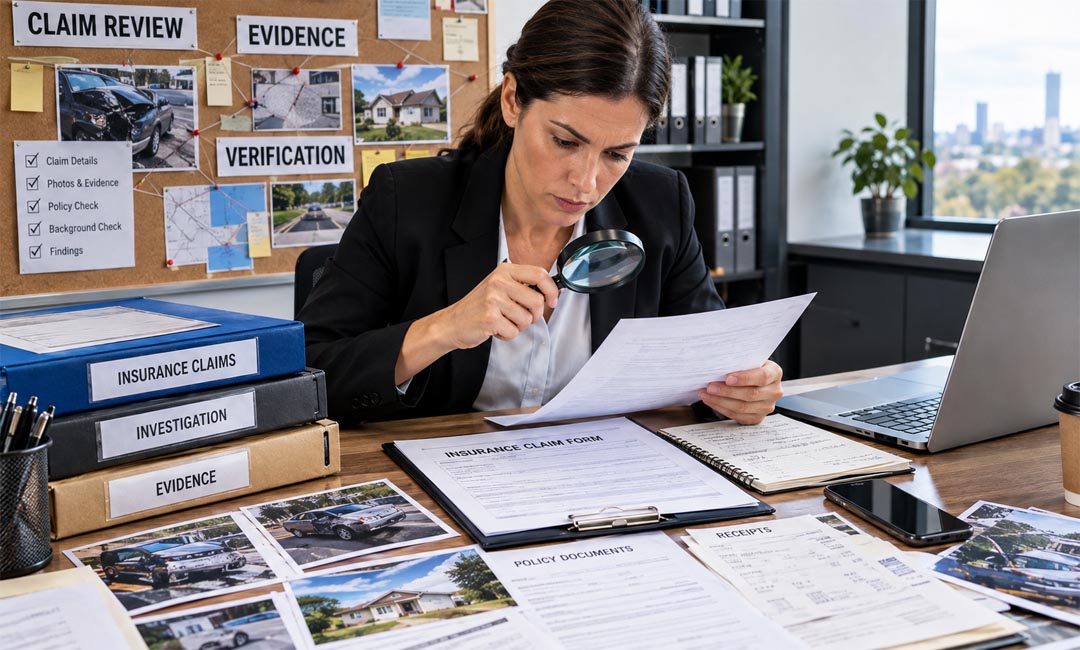
If there is conflicting information in an insurance claim, if there are unusual circumstances, or if there are indications that the loss claimed may not be consistent with the information available, an insurance company may need to investigate the claim further. An insurance claims investigator investigates the facts of a claim, verifies information, interviews relevant parties, reviews documents and collects evidence that may assist an insurer in determining the facts of a claim.
Insurance claims investigation may be used in various insurance claims such as workers compensation, personal injury, public liability, motor vehicle, property, theft and other disputed or complex claims.
The purpose of an investigation is to determine the facts. It does not necessarily imply that a claimant has been at fault. A professional insurance claim investigator must be objective, lawful and report the facts of a claim, not presume it to be a fraudulent claim.
What Is an Insurance Claims Investigator?
An insurance claims investigator is a professional investigator who is hired to collect and confirm information in an insurance claim.
An investigator can be hired when the information an insurer has is incomplete, inconsistent, disputed or needs to be verified. The investigator can interview, review documents, research public records, interview witnesses, make proper observations and prepare a detailed report.
Insurers, claims managers, self-insured organisations, legal representatives or others who are authorised to handle an insurance matter may contact an insurance investigator to assist in the resolution of the insurance matter.
It is not a typical claims assessment position. A claims assessor can examine a policy, determine a loss, and determine if a claim is covered by a policy. When more fact-finding is required, an investigator is typically called in.
Professional insurance investigation services can thus offer an impartial evidence-gathering role in the broader claims process. Private investigators are known to be able to provide insurance fraud investigation and claims investigation services in Australia.
Why Are Insurance Claims Investigated?
An insurance company can refer a claim for investigation for a number of reasons.
Suspected Fraud or Misrepresentation
An investigation may be warranted if there are signs that information provided with a claim is false, incomplete, exaggerated, or misleading.
This could be an alleged loss that doesn’t seem to fit the evidence, changes in circumstances of an incident that can’t be explained, or information that contradicts documents or independent accounts.
An investigator’s role is to establish what the evidence shows. A suspicion should not be considered as evidence of fraud.
Conflicting Statements
Several accounts of an incident can cause confusion.
For instance, the claimant, the witness, the employer and another party in an accident may describe the incident differently. An insurance investigator can talk to the appropriate people and check their accounts against the documentation.
Questionable Circumstances Surrounding a Claim
Some claims are related to situations that need further elucidation.
Investigators can review the time of an incident, where the incident occurred, the sequence of events, communications that occurred prior to the incident, records, and other pertinent information to determine a reliable chronology.
High-Value or Complex Claims
A large or complex claim may require several people, significant financial risk, a lot of paperwork, or conflicting facts.
In such instances, a structured investigation can be used to seek missing evidence and determine what evidence is relevant to the claim.
Disputed Liability
Factual investigation can be used to determine what occurred when there is a difference of opinion regarding responsibility for an incident.
An investigator can interview witnesses, examine information, examine photographs or records, and develop a timeline of events.
Suspicious Patterns or Previous Claims
An insurer might also look into where there is an indication that there is a pattern of claims or repeated circumstances.
Any such information should be assessed carefully and objectively. There is no presumption that a new claim is fraudulent based on previous claims.
How Does an Insurance Claims Investigation Work?
The exact process will vary depending on the type of claim and instructions to the investigator. The following steps are common to a typical investigation.
Initial Case Assessment
The investigator first reads the information provided by the client.
This can involve the claim form, incident reports, policy information, medical or employment records as appropriate, photographs, correspondence, witness information and specific questions that must be addressed.
The investigator then decides what information needs to be substantiated.
Background and Database Research
Investigators may undertake research with publicly available information and authorised databases where legally allowed and appropriate.
The intent is to confirm facts not gather unnecessary personal data.
Research can be used to determine addresses, business information, public records, and relationships among relevant entities or other facts related to the claim.
Witness Interviews
Witnesses can give information that can help to find out what happened.
An investigator may approach witnesses, provide factual information of events, and notify witnesses of the purpose of the investigation, as appropriate.
Statements should be captured accurately and should not be confused with assumptions or conclusions.
Statement Verification
An investigator can compare statements to other evidence.
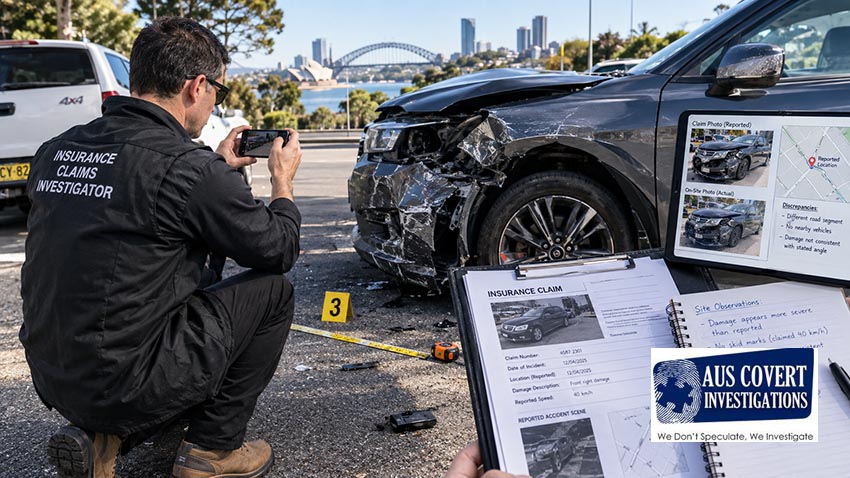
For instance, a claimant’s description of an accident can be compared to a photo, incident report, witness statement, timestamps or other documentation.
The goal is to determine if there is evidence to support, refute or leave unclear specific parts of the claim.
Surveillance Where Appropriate
Surveillance may at times yield relevant evidence, especially when there is a specific and documented concern regarding a person’s claimed activities or capabilities. It is not to be used as a routine component of all investigations.
Australian claims-handling guidelines impose important conditions on surveillance, such as reasonable grounds, consideration of less intrusive methods, lawful conduct and appropriate privacy protection.
Location and Activity Checks
The investigator might confirm locations, activities, businesses, workplaces, accident sites, and/or circumstances, etc., depending on the case. These checks can be used to determine if the information in a claim is consistent with information obtained independently.
Document and Evidence Review
Documents may be a key element of an investigation. The investigator may inspect and review relevant reports, photographs, correspondence, invoices, receipts, employment records, incident documentation, medical information (where appropriately authorised) or any other material which is relevant to the claim.
Preparation of the Investigation Report
The investigation normally concludes with a structured report.
A professional report should describe the investigation, the method used, the evidence gathered, and the inferences that can be made from the evidence.
What Evidence Can an Insurance Investigator Collect?
Depending on the investigation and applicable laws, an insurance investigator may collect:
- Photographic evidence
- Video evidence
- Witness statements
- Publicly available information
- Timeline and activity records
- Relevant claim documentation
- Incident reports
- Location information
- Other evidence obtained through lawful investigative methods
Evidence should be relevant, properly documented and collected in a manner consistent with applicable legal and privacy requirements.
Investigators acting on behalf of insurers must gather information that is reasonably likely to be relevant, abide by the relevant laws and refrain from engaging in unlawful investigative practices, in accordance with the General Insurance Code of Practice.
When is Surveillance Used in Insurance Investigations?
Surveillance may be used where there is credible information that the circumstances of a claim should be independently verified.
In a workers compensation case, for instance, surveillance might be warranted when there is evidence that a person’s reported limitations or activities may be at odds with the information already in the insurer’s possession.
Mobile surveillance and documentation of relevant activities from lawful locations.
But there are legal and privacy limitations on surveillance. In NSW workers compensation cases, the guidance is that surveillance should be based on evidence, used when other less intrusive methods are not sufficient and be conducted lawfully and ethically. It also sets limits on how and where surveillance can take place and how information about other people should be used.
That is why professional insurance investigation services should not make surveillance a standard part of the investigation process.
How Investigators verify information in an insurance claim.
One of the key roles of an insurance investigator is verification.
Investigators may:
- Compare statements from different people.
- Establish a detailed timeline of events.
- Check relevant publicly available information.
- Identify inconsistencies between statements and documents.
- Corroborate important facts using independent evidence.
- Separate confirmed facts from allegations or assumptions.
If a claimant claims that a specific incident took place at a specific time, for instance, an investigator can review records and witness statements to see if there is any consistency.
One discrepancy isn’t necessarily proof of fraud. Individuals may have accurate dates, times, or events in mind, but forget to include the correct details. It is the investigator’s job to evaluate the evidence in total.
Insurance Claims Investigation vs Insurance Fraud Investigation
Insurance Claims Investigation is the investigation of an insurance claim, whereas Insurance Fraud Investigation is the investigation of an insurance fraud. An insurance claims investigation is more comprehensive than an insurance fraud investigation.
An investigation may be performed just because an insurance company requires the additional information to understand an incident, to determine liability, to confirm a loss, or to resolve conflicting information.
An insurance fraud investigation is more narrowly directed to determining if there was intentional deception or other fraudulent activity. A routine investigation may escalate into a fraud investigation if evidence indicates that the information was deliberately misrepresented, fabricated, or was the result of some other type of suspected fraudulent activity.
This is important because investigators should be evidence-based. The investigator should collect facts and report findings, not make assumptions that fraud has taken place.
What Does an Insurance Investigation Report Include?
Typically, an insurance investigation report will contain the following information:
- Case background
- Instructions provided to the investigator
- Investigation methodology
- Interviews conducted
- Observations
- Evidence obtained
- Chronology of relevant events
- Supporting photographs or documentation
- Relevant inconsistencies
- Findings and factual conclusions
The report should be prepared in such a way that the insurer, claims manager, lawyer, or other authorised decision-maker will be able to understand the process used to gather the information and the evidence that is presented.
According to AusCovert Investigations, their insurance investigation services include researching information provided by the insured, gathering information from parties involved in claims, conducting further investigation, documenting the results, and reviewing case documentation.
How Long Does an Insurance Claims Investigation Take?
No one time frame fits all insurance investigations.
A relatively simple factual inquiry might take a few days. A complex investigation with many witnesses, lots of documentation, hard-to-find individuals or surveillance can take weeks or even months.
Things that can influence the timeframe are:
- Complexity of the claim
- Number of witnesses
- Availability of relevant records
- Location of the parties
- Need for interviews
- Need for surveillance
- Difficulty verifying information
- Number of issues requiring investigation
- Response times from third parties
A professional investigator should give realistic expectations according to the situation of the particular case.
Choosing an Insurance Claims Investigator in Australia
Here are some factors to take into account when choosing an insurance claims investigator:
Experience
Search for investigators that have experience in the kind of claim involved, like workers compensation, personal injury, public liability, motor vehicle, or property claims.
Relevant Investigation Capability
The investigator needs to have the practical skills necessary for the assignment, such as factual investigations, interviewing witnesses, collecting evidence, researching, and surveillance as necessary.
Professional Reporting
Reports are clear, factual, well-structured and backed up with relevant evidence.
Confidentiality
Investigations into insurance claims may contain personal and commercial information that is sensitive. The investigator should have proper procedures for dealing with confidential material.
Legal Compliance
Investigative techniques must be consistent with Australian legislation, licensing conditions, privacy laws and surveillance regulations.
Communication
The scope of the investigation, progress, evidence gathered and any issues that may impact the investigation should be clearly communicated by the investigator.
According to AusCovert Investigations, all investigators at AusCovert go through a licensing process that includes National Police and Criminal History checks and its insurance investigations are performed with a focus on ethical and professional evidence gathering.
FAQ
Conclusion
An insurance claims investigation is a process that helps to determine facts when a claim is more than a routine assessment.
An insurance claims investigator with experience can review documents, interview witnesses, verify statements, research relevant information, evaluate timelines, undertake appropriate surveillance and prepare a detailed report. The aim is to give the authorised decision-maker factual evidence to help make a decision.
Professional investigations must always be carried out lawfully, objectively, confidentially and proportionately. Surveillance and other intrusive investigative techniques should be employed only when necessary and authorized by law.
AusCovert Investigations offers insurance investigation services to assist with disputed, complex or potentially suspicious claims across Australia, including factual investigation and insurance related evidence collection.

Recent Comments