

Free Consultation at 1800 553 788
The recruitment process of the right employee is one of the most crucial process for any business. From recruiting for a small business to a large corporation, government agency, or specific industry, comprehensive employment background checks can help mitigate hiring risks, maintain workplace integrity and ensure candidates have the skills and experience they claim.
Australia is leading the way in the adoption of pre-employment screening and employee verification systems to uncover any potential worries before hiring. Background checks, however, must be done with care and according to Australian privacy and employment legislation.
This guide outlines important considerations surrounding employment background checks in Australia and how employment background checks can assist employers in making informed hiring decisions.
What Is an Employment Background Check?
An employment background check is a process undertaken to validate information given by a job applicant when they are being hired. To verify the accuracy of candidate’s skills, work experience, references and other pertinent documents prior to a job offer.
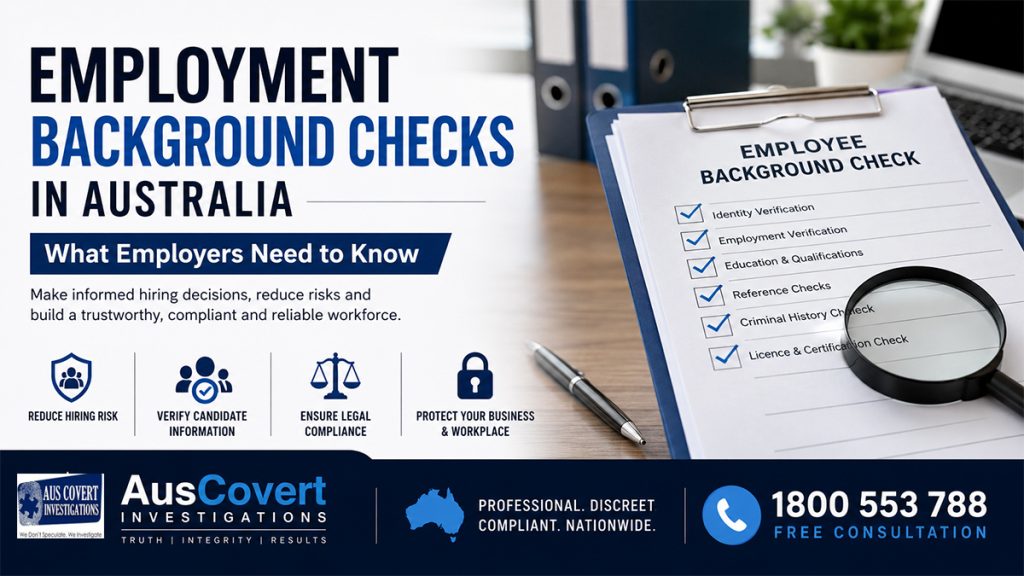
A detailed pre-employment background check may include: Verification of employment:
-
Criminal history checks
-
Education verification
-
Qualification and licence checks
-
Reference checks
-
Identity verification
-
Right-to-work verification
-
Professional certification validation
These checks ensure that employers determine that the person applying is a suitable candidate for the position they are interested in and reduce the chance of fraudulent applications.
Why Employers Conduct Pre-Employment Screening
Employers perform pre-employment screening for good reasons.
Pre-employment screening is now a pivotal part of the recruitment and workforce processes.
Employers recruit for a variety of reasons and perform employee screening for several reasons.
Reduce Hiring Risks
The consequences of a bad hiring choice can include financial losses, reduced productivity, work disruption, and damage to reputation. Screening helps detect inconsistencies before hiring.
Protect Workplace Safety
Background verification is especially useful for roles with access to sensitive information, security clearance, financial duties, and vulnerable individuals, as it provides an added layer of trust for the employer.
Verify Candidate Claims
Sometimes resumes and job applications will be incorrect when it comes to qualifications, work experience, certifications, or achievements. Employment verification helps confirm the authenticity of these claims.
Maintain Regulatory Compliance
Some employers will have certain checks that are required before new hires are accepted. This can mean work in health care, education, childcare, aged care, security, financial services, and more.
Common Types of Employment Background Checks
Background checks are usually a series of verifications.
Identity Verification
Employers verify a person’s identity with government documents.
Employment Verification
Previous employers are contacted for verification of:
- Job titles
- Employment dates
- Duties and responsibilities
The reasons for the exit (if applicable)
Education Verification
Schools can be called to verify:
- Degrees
- Diplomas
- Certificates
- Attendance dates
- Academic achievements
Professional Licence Verification
Some jobs need a current licence, registration or certification before hiring.
Reference Checks
Professional references can provide valuable insights regarding a candidate’s work ethic, reliability, performance, and interpersonal skills.
Criminal Background Screening
Employers might conduct criminal background checks to gauge risk, depending on the position.
Criminal History Checks and Legal Considerations
One of the most usual employment background checks in Australia is criminal history checks. But employers need to be mindful about and legal when conducting these checks.
You need not refuse to hire someone if their criminal record shows that they have committed a felony. Employers should assess:
- The severity of the punishment for the offence
- The seriousness of the offence
- The length of time that has passed since the offence took place.
- Relevance of the offence to the position
The common law rule that a criminal record must be relevant to the inherent duties of the position is usually applied in Australian anti-discrimination legislation.
For instance, a historical crime that is not related to the job may be unimportant, while crimes involving financial fraud may be important for a role that deals with finances.
Employers should not be guided by blanket policies that automatically disqualify applicants for any criminal record.
Employment Verification and Work History Reviews
One of the most valuable parts of pre-employment screening is employment verification.
A work history review enables employers to verify that a candidate’s work experience is as represented.
Typical areas that are checked are:
Employment Dates
Verification verifies employment of the candidate by other employers.
Job Titles
Inflated or misleading job titles may indicate misrepresentation.
Duties and Responsibilities
Understanding a candidate’s actual responsibilities helps determine whether they possess the required experience.
Employment Gaps
If there are significant periods of unemployment without satisfactory explanation, further detail may be required.
Career Progression
An examination of a candidate’s work history can provide clues as to whether he or she has advanced in a steady fashion, remained stable, or jumped from job to job.
Rigorous job verification ensures that recruitments are made with authority and decreases recruitment uncertainty.
Education, Qualifications, and Certification Checks
There is a concern for qualification fraud in multiple industries. In the process of obtaining more education, some candidates may overstate or lie about what they have learned to enhance their employment opportunities.
Education verification allows employers to confirm:
-
Degrees and diplomas
-
Trade qualifications
-
Vocational certifications
-
Professional registrations
-
Industry accreditations
This is especially relevant for roles that involve specialized skill and/or compliance with regulations.
Employers should also make sure that licences and certifications are up to date and current.
Examples include:
- Security licences
- Medical registrations
- Trade certifications
- Financial services qualifications
- Engineering registrations
Verification safeguards organisations against non-compliance and professional liability issues.
Reference Checks: Best Practices for Employers
When done properly, reference checks are an excellent employee screening tool.
Many employers don’t have a thorough reference check process or routinely disregard them altogether because of time limitations.
To maximise effectiveness:
Use Professional References
Prioritise supervisors, managers, or direct reporting authorities rather than personal references.
Ask Consistent Questions
A structured response will enable employers to compare answers fairly.
Focus on Job Related Competencies
Questions should address:
- Reliability
- Attendance
- Teamwork
- Communication skills
- Leadership ability
- Performance standards
- Professional conduct
Verify Relationship Authenticity
Make sure that the reference was truly a work collaborator and can be helpful.
Document Findings
Record keeping contributes to uniformity and clarity in the hiring process.
A good reference check can discover strengths, concerns, and work behaviours that may not be seen in the interview.
Privacy Laws and Employee Consent Requirements in Australia
Rules regarding privacy and employee consent in Australia.
It is essential that employment background checks adhere to Australian privacy laws.
Employers should have informed consent from candidates before running background checks.
Some of the fundamental privacy concepts are:
Transparency
Candidates should understand:
- What information will be collected
- Why it is being collected
Indicate how the film will be played.State the use of the film.
Relevance
Only data pertinent to the job should be gathered.
Confidentiality
The results of the background checks must be kept securely and only shared with authorised personnel.
Data Security
Employers have a responsibility to take reasonable measures to prevent unauthorised use, misuse or disclosure of personal data.
Failure to comply with privacy obligations may expose organisations to legal and reputational risks.
Red Flags Employers Should Assess Carefully
Not every inconsistency means that someone is lying. However, some indicators may require further investigation.
Some of the following may indicate a potential red flag:
Inconsistent Employment History
Clarifications may be needed as there may be differences between resumes, applications and verification findings.
Unverified Qualifications
Any educational qualifications not verified should be checked thoroughly.
Frequent Short-Term Employment
Multiple temporary jobs could be a sign of instability or employment issues, but there are reasonable reasons for this.
Significant Employment Gaps
Long spells of unemployment may need further discussion.
Reluctance to Provide References
If a candidate does not include professional references, they could be subject to further questioning.
Contradictory Reference Feedback
A mismatch among various components of a reference may indicate a problem with performance or conduct.
Employers need to look at red flags objectively and give their candidates the chance to explain any discrepancies before making a decision.
How Professional Investigators Can Assist with Employment Screening
Many institution opt to work with skilled investigators to have detailed employee screening and background checks performed.
Professional investigators can help by:
- Performing comprehensive employment background checks
- Cross-referencing with employment history and records
- Confirming training certification and qualifications
- Performing reference investigations
- Identifying discrepancies in candidate information
- Performing legitimate background checks
- Assisting in due diligence procedures
Independent verification adds a level of authenticity and impartiality during hiring. Professional screening can help minimize risk for employers who are entering the labor market for senior executives, financial personnel, security-sensitive positions, or people working in positions of trust.
How AusCovert Investigations Supports Thorough Employment Background Checks
At AusCovert Investigations, we know, employment is a business function that directly affects organisational success, safety and reputation.
Our skilled investigators can deliver professional employment background check solutions for Australian employers in a variety of industries.
We help businesses with:
- Employment verification
- Background verification
- Reference checks
- Qualification and certification validation
- Candidate due diligence
- Pre-employment screening support
- Risk assessment investigations conducted in the workplace.
We conduct investigations without attracting attention, respectfully and according to legal and privacy laws in Australia.
Our comprehensive employee screening solutions provide you with the information you need to make informed hiring decisions with confidence, whether you are recruiting one employee or thousands.
If you wish to discuss employment background checks, pre-employment screening or workplace investigations in a confidential manner, please reach out to AusCovert Investigations today on 1800 553 788 for a free consultation.
Conclusion
Background checks on prospective employees are an integral component of good hiring practices in Australia. Pre-employment screening can boost the confidence of the employer in verifying the candidate’s qualifications, prove the work history, identify potential challenges, and ensure that the employer does not make expensive hiring errors.
Through these four steps, employers can enhance recruitment results and workplace safety, as well as streamline their hiring process.
Collaborating with trusted experts like AusCovert Investigations gives an extra layer of reassurance when making important hiring choices that you have accurate, reliable and complete information.
FAQ

Recent Comments